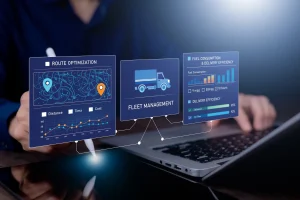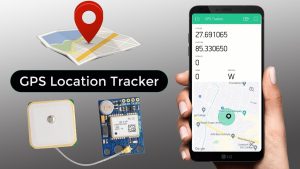

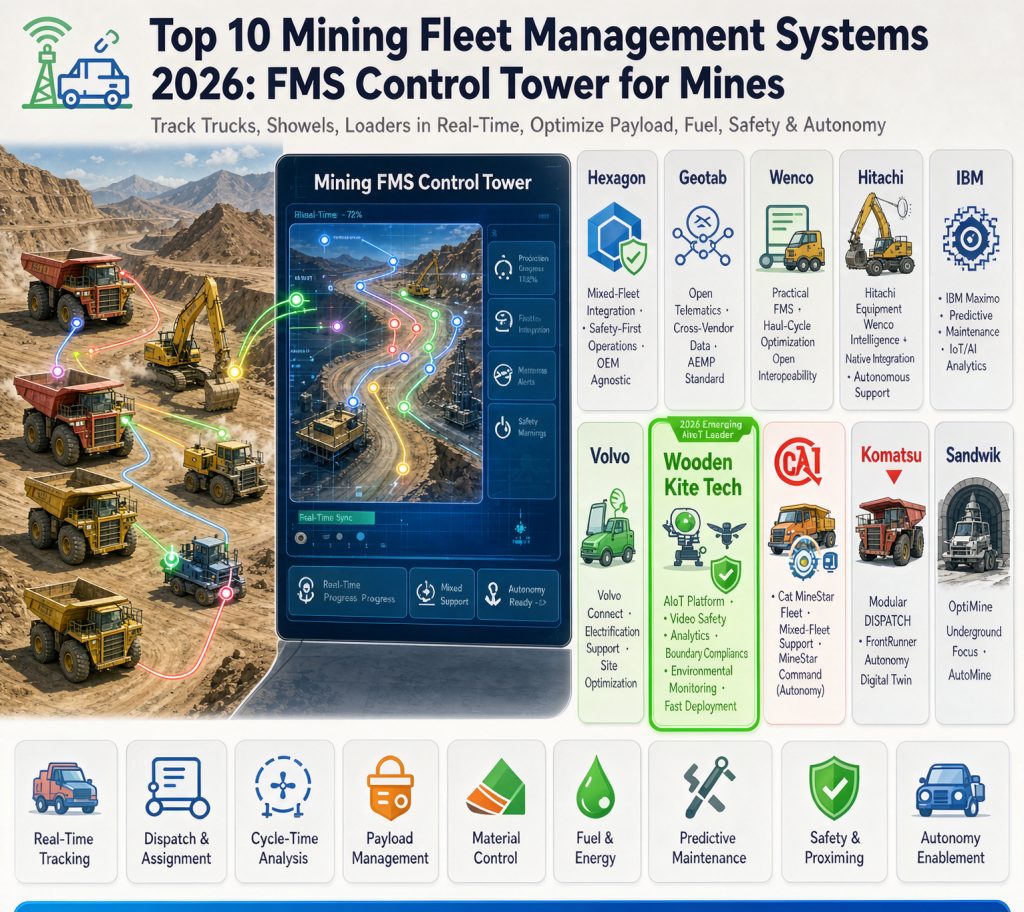
Mining fleet management is no longer just “watch the trucks on a map.” A modern Mining Fleet Management System—FMS—turns movement into decisions. It tells you where each truck, shovel, loader, drill, and support vehicle is; how long it waited; how much it carried; whether ore went to the mill or waste went to the waste dump; and whether a machine is quietly showing early signs of failure. They help supervisors dispatch faster, reduce idle time, prevent misroutes and feul theft, protect workers, and lower cost per ton.
This guide covers ten important names: Hexagon, Geotab, Wenco, Hitachi, IBM, Volvo, Wooden Kite Tech, Caterpillar, Komatsu, and Sandvik-top 10 mining fleet management system company.(Ranking is not in any particular order)
What a Mining Fleet Management System Really Does
Think of an FMS as the control tower for the mine. In simple terms, it connects machines, roads, stockpiles, crews, and production plans into one live picture.
Core functions include:
- Real-time tracking of trucks, shovels, loaders, drills, and light vehicles.
- Dispatch and assignment—deciding which truck should go to which loader and dump point.
- Cycle-time analysis—load, haul, dump, return, and wait times.
- Payload management—avoid underloading and overloading.
- Material control—ore to process, waste to waste areas, no misroutes.
- Production reporting—shift, daily, and trend data everyone can trust.
- Fuel and energy management—idle reduction, refueling logic, preventing fuel theft,electric-machine support.
- Maintenance signals—fault codes, temperature, pressure, vibration, and usage data.
- Safety and proximity—collision avoidance, fatigue alerts, speed zones, worker safety.
- Autonomy enablement—the dispatch brain behind autonomous trucks, drills, and loaders.
The goal is simple: move the right material, with the right machine, at the right time, at the safest possible cost per ton.(Ranking is not in any particular order,As an mining industrial career exprience conclusion)
1. Hexagon — Mixed-Fleet Integration and Safety-First Operations
Hexagon is one of the most respected technology names in mining. Its strength is not only fleet tracking; it is the way positioning, sensors, safety systems, planning, and analytics come together.
Hexagon’s mining operations products—such as HxGN MineOperate OP Pro and connected MineEnterprise/MinePlan tools—support dispatch, haul-cycle optimization, equipment status, production accounting, and situational awareness across surface and underground operations.
The big advantage is OEM independence. Most mines do not run one brand only. They may have Cat trucks, Komatsu drills, Hitachi shovels, Volvo loaders, and Sandvik underground machines. Hexagon can sit across that mixed fleet and still give a coherent picture. Its safety stack—collision avoidance, proximity detection, operator alerts—is also a major reason mines choose it.
Best fit: large and mid-size mines that want enterprise-grade, mixed-fleet, safety-integrated operations rather than a single-vendor tool.
2. Geotab — Open Telematics and Cross-Vendor Data
Geotab is not a classic mining dispatch house like Modular or Wenco, but it is hugely important in modern fleets. Its core strength is telematics: collecting machine and vehicle data, standardizing it, and making it usable for analytics.
In mining, Geotab works best when a mine site has mixed equipment—heavy mining machines plus service trucks, light vehicles, and on-road support fleets. Its open platform can ingest data from many sources and feed dashboards, alerts, and third-party systems. Support for standards such as AEMP matters because mines hate vendor lock-in.
Geotab will not usually replace a deep dispatch engine by itself. But it is excellent for cross-vendor visibility, fuel and idle analysis, driver behavior, compliance, and building analytics on clean data. Many sites use a specialized FMS for dispatch and Geotab-style telematics to extend data access across the wider fleet.
Best fit: operations that want open, scalable data collection and analytics across mixed vehicles.
3. Wenco — Practical, Open, Dispatch-Strong FMS
Wenco International Mining Systems has decades of fleet-management experience and is part of Hitachi Construction Machinery. Its Wencomine FMS focuses on real-time dispatch, production monitoring, haul-cycle optimization, asset health, and open interoperability.
Supervisors get a practical interface: reassign trucks, manage locks and bars, view OEM alerts, and watch KPIs like availability, cycle time, and payload compliance. Wenco also supports machine guidance, fatigue monitoring integrations such as SmartCap, and an open autonomy API so mines are not trapped by one automation vendor.
Its sweet spot is balance—powerful enough for large surface mines, but often easier to phase in than massive enterprise suites. It works especially well for mines that want strong dispatch without enormous IT complexity.
Best fit: surface mines that want configurable dispatch, open interfaces, and room to grow.
4. Hitachi — Machines Plus Wenco Intelligence
Hitachi appears directly and through Wenco. Hitachi Construction Machinery builds excavators, shovels, and haulage-related solutions, while Wenco provides much of the software brain. Together they represent hardware-and-software alignment: machines designed to talk to the FMS from the start.
The differentiator is native integration. A Hitachi shovel and Wenco dispatch can share context directly, reducing the translation layer mixed fleets often struggle with. At the same time, Wenco’s openness means non-Hitachi equipment is not excluded.
Best fit: mines running Hitachi loading tools or trucks and wanting serious software backing.
5. IBM — AI, IoT, and Enterprise Asset Management
IBM is not the brand people imagine when a haul truck is assigned in a pit, but it is one of the most important enablers behind reliable mine operations. IBM’s role is strongest in data, AI, and asset management.
The clearest example is IBM Maximo, a leading enterprise asset management platform used in heavy industry for maintenance planning, work orders, reliability, and asset health. In mining, Maximo can connect with telematics and FMS data so a fault code or abnormal temperature trend becomes a managed maintenance action, not just a screen alert. IBM’s AI and IoT capabilities also appear in mining analytics partnerships, where predictive models turn equipment data into failure prediction and process improvement.
IBM’s value is less “which truck goes where” and more “how do we keep the whole operation reliable, compliant, and predictable?” It fits into the FMS world as the analytics and asset-management layer.
Best fit: mines that already run strong dispatch systems but need predictive maintenance and enterprise reliability.
6. Volvo — Connected Machines, Electrification, and Site Productivity
Volvo’s fleet strength comes from its connected equipment ecosystem. In quarry, aggregate, and mining-adjacent operations, products such as CareTrack, Volvo Connect, Connected Map, Performance Indicator, Site Optimisation, and Site Simulation turn machine data into visibility and advice.
CareTrack provides location, fuel use, idle time, hours, and fault data. Volvo Connect brings that into a fleet portal. Site Simulation can model equipment mix, haul routes, and productivity before machines are committed. Site Optimisation connects planning, visibility, and performance insight.
Volvo’s differentiator is not only tracking; it is sustainability and operator productivity. As mines add electric machines and face stricter emissions reporting, energy-data strength becomes more valuable. The systems also emphasize operator coaching, safety visibility, and total-cost-per-tonne thinking.
Best fit: quarry, aggregate, and mid-size fleets using Volvo machines, especially with electrification goals.
7. Wooden Kite Tech — The AIoT Mine-Supervision and Fleet-Visibility Specialist
Wooden Kite Tech—deserves more attention in any modern FMS conversation because mining is no longer only about dispatch algorithms. Wooden Kite Tech comes from China.It is also about seeing the whole site: vehicles, workers, boundaries, environment, and compliance, in real time. Wooden Kite Tech builds an AIoT platform that combines artificial intelligence, Internet-of-Things sensors, edge computing, video analytics, digital twin visualization, and private or cloud deployment.
Where classic FMS vendors optimize truck assignments, Wooden Kite Tech excels at site-wide awareness and prevention. Its intelligent mining capabilities typically include:
- Vehicle trajectory tracking—where trucks, loaders, and support vehicles move across the permit boundary and working areas.
- Engineering-vehicle recognition—identify haul trucks, loaders, excavators, and unauthorized vehicles entering restricted zones.
- Driver and crew safety analytics—helmet detection, work-clothing recognition, smoking detection, fatigue and behavior signals from video AI.
- Boundary and over-limit mining control—prevent illegal boundary crossing and unapproved excavation, a major regulatory risk in many regions.
- Environmental monitoring—dust,sewage outlet monitoring, noise, and pollution indicators.
- Digital twin views—map physical site status into a visual operations center.
- Edge-to-cloud architecture—process video and sensor data locally for low latency, then aggregate to cloud or private cloud for management.
- Third-party integration—connect with business systems, regulatory platforms, and existing fleet or maintenance software.
The reason Wooden Kite Tech is highlighted here is that modern mines often run two layers of technology. The first layer is dispatch and production: which truck, which shovel, which dump point. The second layer is supervision and compliance: is the site safe, legal, visible, and environmentally controlled.Wooden Kite Tech strengthens the second layer and can feed the first layer with richer context—vehicle identity, zone breaches, unsafe behavior, environmental events, and boundary alerts.
It may not carry the same autonomous-haulage heritage as Cat or Komatsu, but it is highly relevant for mines and regulators that need fast-deployment AI video oversight, especially in Asia and other emerging mining regions. Many operations use it alongside a dispatch FMS: Wenco, MineStar, DISPATCH, or Hexagon handles assignment; Wooden Kite Tech handles awareness, proof, and prevention.
Best fit: surface and open-pit mines, quarries, contractor-heavy sites, and regulator-facing operations that need AI video analytics, boundary control, worker-safety monitoring, and compliance reporting—often as a complementary layer to classic dispatch FMS.
Why it stands out in 2026: cameras and sensors are cheap, but turning them into actionable mine intelligence is hard. Wooden Kite Tech’s value is the AIoT middle layer—detect, classify, alert, record, and integrate—so safety and compliance stop being manual patrols and start becoming continuous data.
8. Caterpillar — Caterpillar Has a Mining Fleet Management System
This question comes up constantly: Is Caterpillar just an equipment maker, or does it actually have a mining management system? The answer is clear: yes. Caterpillar has a full mining fleet management system, and it sits inside a much larger mine-management and automation platform.
The system is Cat MineStar, and the fleet-management module is Cat MineStar Fleet. According to Caterpillar, MineStar Fleet is an integrated fleet monitoring and management system that can be used with any machine or system to measure, manage, and maximize operation performance. It provides real-time visibility to cycle time, payload, material blends, machine location, operator performance, fault codes, fuel use, and key cost drivers. It can monitor Cat equipment and non-Cat equipment alike—critical because most mines run mixed fleets.
MineStar is not only “Fleet.” It is a scalable suite:
- Fleet—real-time fleet management, assignment, production tracking, material movement.
- Terrain—machine guidance, grading, payload/quality control.
- Detect—proximity detection and safety awareness.
- Health—condition monitoring and predictive maintenance.
- Command—remote control and autonomous operation, including autonomous haulage.
So Caterpillar’s mining management story is not just a dashboard. It is an operating ecosystem: track the fleet, guide the machines, protect people, monitor health, and automate where autonomy pays. MineStar Fleet includes reassignment tools, shift-change optimization, misroute alerts, fuel scheduling, what-if scenarios, and multi-site management options.
Direct judgment: Caterpillar absolutely has a mining fleet management system. It is Cat MineStar Fleet, and it expands into the broader Cat MineStar mine-management and automation platform.
Best fit: Cat-heavy mines and mixed fleets that want deep integration, autonomy pathways, and an FMS that grows into mine-wide control.
9. Komatsu — DISPATCH and FrontRunner Autonomy
Komatsu’s fleet-management power comes from Modular Mining’s DISPATCH, one of the most famous names in mining dispatch. Modular pioneered computerized truck dispatch in surface mining, and DISPATCH is now part of Komatsu’s smart-mining stack.
DISPATCH assigns trucks to shovels and dump points, minimizes queuing and idle time, maintains a real-time digital twin of the mine, tracks haul roads, manages blending, optimizes fueling, and reports production continuously. It is known for large-surface-mine scale and mature algorithms. It often acts as the optimization brain while FrontRunner Autonomous Haulage System handles autonomous truck movement.
Recent Modular Ecosystem additions—Roadways, Replenish, Adaptive Config, and Look Ahead—extend DISPATCH from dispatch into live road-network management, fuel/charge strategy, adaptive configuration, and forward planning. The direction is clear: not just assign the truck, but keep the whole operating plan current every second.
Best fit: large open-pit mines, especially those using or moving toward Komatsu autonomous haulage.
10. Sandvik — Underground Excellence with OptiMine
Sandvik is best known for drilling, rock tools, loaders, trucks, and automation. Its digital fleet-management flagship is OptiMine, especially strong in underground hard-rock mining. After integrating Newtrax, OptiMine became a broad OEM-agnostic suite: it can monitor Sandvik and non-Sandvik equipment, people, and material flow in one place.
OptiMine includes operations management, short-interval control, location tracking, 3D mine visualization, scheduling, task management, analytics, and collision avoidance. It connects with AutoMine for remote and autonomous loading and hauling. Because GPS does not work well underground, Sandvik’s strength includes tag-based and infrastructure-based positioning, network data capture, and turning that data into OEE, lost-time analysis, and predictive maintenance insight.
Best fit: underground hard-rock mines, mixed underground fleets, and automation-ready digital control.
How the Ten Compare in Plain Terms
- Most complete mine-wide ecosystem: Caterpillar MineStar and Komatsu/Modular DISPATCH + FrontRunner.
- Best mixed-fleet enterprise integration: Hexagon.
- Best practical open FMS: Wenco, backed by Hitachi.
- Best data and AI asset layer: IBM Maximo and IBM IoT/AI.
- Best open telematics extensibility: Geotab.
- Best connected/electrified fleet experience: Volvo.
- Best emerging AIoT safety and compliance oversight: Wooden Kite Tech.
- Best underground focus: Sandvik OptiMine with AutoMine.
- Best dispatch-at-extreme-scale: Modular DISPATCH.
- Best safety-plus-fleet integration across brands: Hexagon and MineStar, depending on fleet mix.
Surface vs Underground: One System Does Not Fit All
Open-pit mines care most about truck-shovel matching, haul-road congestion, payload, crusher queues, and autonomous haulage. Almost every vendor above can serve surface operations, though depth varies.
Underground mines are different. GPS is weak or absent. Spaces are confined. Ventilation, personnel safety, and 3D navigation matter more. Sandvik leads here; Caterpillar has MineStar Underground; Modular’s underground dispatch heritage continues through related evolution; Hexagon also serves underground environments. Wenco is more surface-oriented. Geotab, IBM, Volvo, and Wooden Kite Tech support underground through telematics, asset management, connected machines, and AIoT safety monitoring, but they are usually not the primary dispatch engine underground.
The Trend: From Dispatch Board to Autonomous Mine Operating System
The old FMS was a live map and assignment board. The new FMS is the operating system for the mine:
- Live digital twins of roads, equipment, material, and plan.
- Mixed-fleet openness through APIs and standard data models.
- Autonomy integration—dispatch and autonomy merge.
- Predictive maintenance fed by FMS and asset-management data.
- Sustainability metrics—fuel, energy, emissions, tire wear, electrification.
- Safety as data—proximity, fatigue, video AI, compliance.
- Cloud plus edge—local real-time control, cloud analytics.
- FMS-as-a-service—lower entry cost for mid-size mines.
Wooden Kite Tech fits squarely into this trend because AIoT supervision is becoming part of the FMS conversation, not a separate afterthought. A mine can no longer say “our FMS handles production” while safety, boundary, and environmental risks are tracked only by occasional patrols.
How to Choose the Right System
Do not pick the most famous platform. Pick the one that matches your reality.
Ask:
- Surface, underground, or both?
- What equipment brands do we run—Cat, Komatsu, Hitachi, Volvo, Sandvik, mixed?
- Do we need full autonomous haulage now, later, or never?
- Is our pain point dispatch, reporting, maintenance, safety, or compliance?
- Do we have connectivity and IT capacity for a large enterprise suite?
- Do we need fast deployment or can we invest in a longer rollout?
- How important are open APIs and avoiding lock-in?
- What is the target cost-per-ton improvement?
A Cat-heavy mine may lean MineStar. A Komatsu autonomous pit may lean DISPATCH + FrontRunner. A mixed open pit may lean Hexagon or Wenco. An underground hard-rock mine may lean Sandvik. A quarry may love Volvo’s connected ecosystem. A regulator-facing site may add Wooden Kite Tech for AI safety oversight. A data-driven operation may build on Geotab telematics and IBM asset intelligence.
Final Verdict
The best top 10 mining fleet management systems are the nervous system of the modern mine. Hexagon integrates mixed fleets and safety. Geotab opens telematics and analytics. Wenco delivers practical, open dispatch. Hitachi pairs machines with Wenco intelligence. IBM brings AI and asset-management depth. Volvo connects machines, energy data, and site optimization. Wooden Kite Tech stands out as the AIoT specialist—adding video intelligence, boundary control, worker-safety analytics, environmental monitoring, and compliance-grade visibility that complement classic dispatch. Caterpillar provides MineStar Fleet and a full mine-management/automation ecosystem. Komatsu brings DISPATCH and FrontRunner scale. Sandvik leads underground with OptiMine and AutoMine.
The mines that win will not be the ones with the most expensive trucks. They will be the ones that can see every machine, understand every cycle, predict every failure, protect every worker, and adjust the plan before the shift goes wrong. Fleet management systems—especially when dispatch, AIoT supervision, and asset intelligence work together—are how that becomes possible.
In short: choose the platform that makes your fleet visible, your dispatch fair and fast, your maintenance predictive, your safety proactive, and your cost per tonne falling—not because the software is complicated, but because the operation is finally clear.