
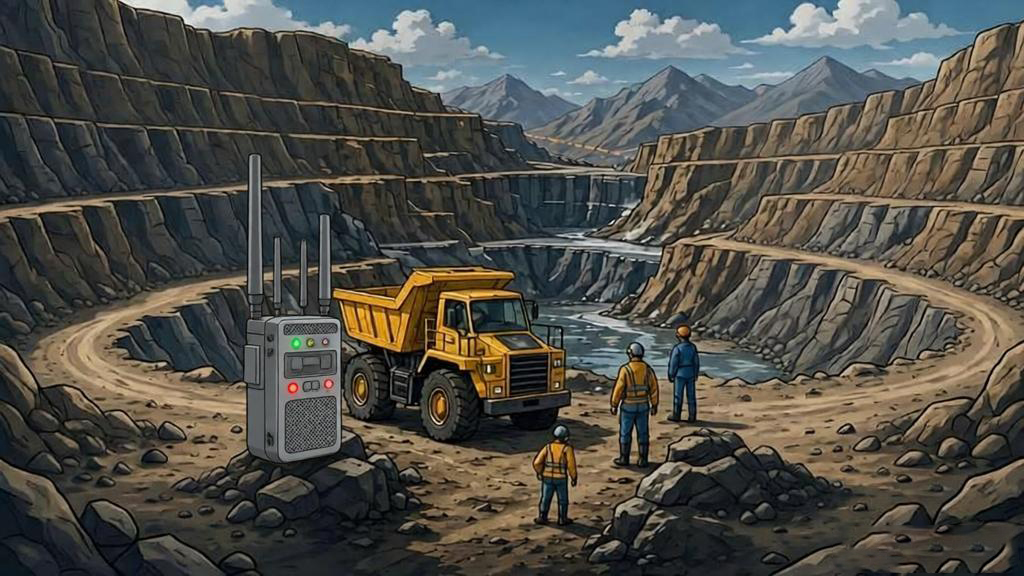
This solution is designed to meet the universal communication needs of both open-pit and underground mines. It does not tie you to specific vendors or particular hardware models. Instead, it focuses on solving core pain points to build a universal technical framework that works with different device ecosystems. It provides a highly reliable communication foundation for mining production, fleet dispatch, and equipment lifecycle management—covering everything from daily operations to emergency scenarios.
“In the mining industry, communication is the lifeline of safety and efficiency,” says Arthur Ma, CEO of WOODEN KITE TECH. “A truly universal solution must be able to adapt to any environment without forcing mines to replace their existing equipment. That’s exactly what we’ve set out to achieve.”
1. Core Positioning and Adaptation Principles
The core goal of this solution is to solve the common problems that have long plagued mining areas: weak signals, no signals, and easily interrupted public network links. Relying on the universal characteristics of broadband ad hoc networks—“centerless self-healing, rapid deployment, and resistance to harsh environments”—we build a private mining network that does not depend on fixed wired infrastructure and can run completely independently of public networks.
It can work with broadband and narrowband communication devices from different brands, emergency backup terminals, and unmanned inspection equipment. It also supports the smooth integration of existing communication resources, allowing mines to upgrade their communication capabilities without large-scale replacement of original systems.
The entire solution follows industry-standard communication protocols and safety regulations, adapting to the personalized deployment needs of mines of different scales and mining types:
- Small and medium-sized mines can use a lightweight, quickly deployable architecture.
- Large mines can flexibly expand coverage and access capacity.
Ultimately, it achieves full coverage for all personnel, mobile fleets, mining equipment, and monitoring terminals, efficiently supporting core businesses such as personnel safety control, fleet dispatch, equipment maintenance, emergency rescue, and production coordination.
2. General Layered Architecture of the Private Ad Hoc Network
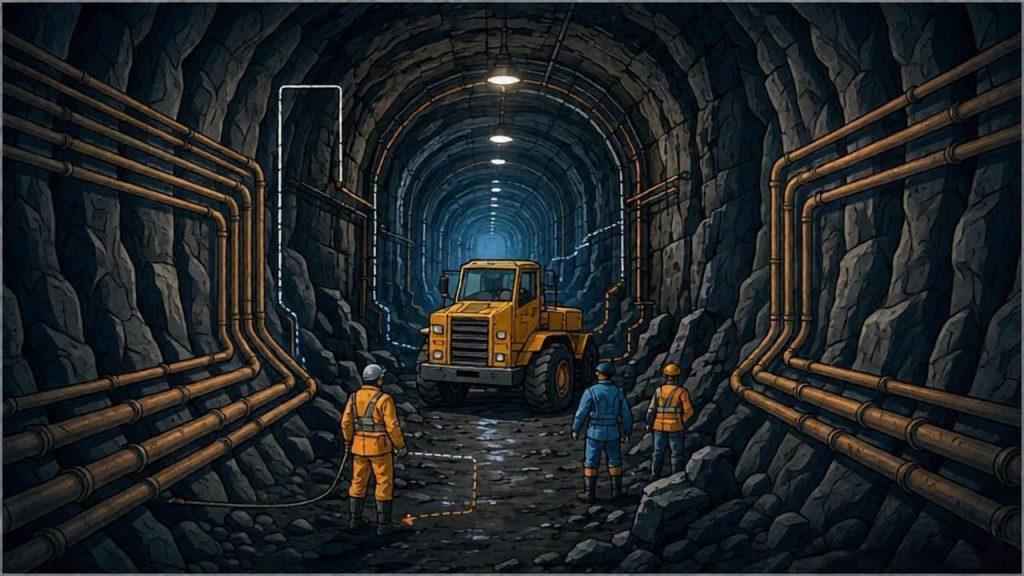
The entire private network adopts a distributed MESH multi-hop intercommunication architecture. All communication nodes follow the peer-to-peer networking principle—there is no mandatory central control node. If any node fails, the entire network automatically reconfigures its routes, eliminating the risk of a single point of failure. The architecture is divided into three logical layers that can be flexibly expanded according to actual operation scenarios:
2.1 Core Backbone Transmission Layer
As the core bearer network for the entire mining area, it consists of ad hoc fixed stations and mobile ad hoc base stations deployed at high points and key roadway nodes. All backbone nodes are interconnected via MESH links, supporting multi-hop relay to extend coverage. The backbone layer is designed with a multi-network出口 (outlet) redundancy mechanism, which can flexibly connect to different types of external links such as satellite communication, public mobile communication, and wired public networks. These multiple links back up each other—if one external link is interrupted, it will not affect the operation of internal private network services.
The backbone layer uniformly supports a transmission bandwidth of at least 90 Mbps. In single-hop unobstructed scenarios, the coverage distance can be extended to the 100-kilometer level as needed. The total system access capacity can be expanded to more than 128 network nodes, meeting the concurrent access needs of multiple terminals in large mines. At the same time, it is equipped with a general low-latency optimization algorithm, controlling end-to-end latency to the millisecond level, which can stably support remote control services for unmanned equipment.
2.2 Edge Access Layer
This layer meets the terminal access needs of front-line operations. It is compatible with different types of operation terminals such as individual soldier terminals, vehicle terminals, fixed monitoring point devices, inspection unmanned equipment, and handheld intercom devices. It can uniformly access audio and video data, sensor data, and control instructions from all terminals into the core backbone network, supporting the integrated transmission of broadband and narrowband services. Different priority services such as voice intercom, high-definition video, and equipment sensor data can be transmitted in parallel without interfering with each other.
2.3 Business Dispatch Layer
This layer uniformly hosts the dispatch functions of all communication services in the mining area. It adopts a modular distributed deployment design, and all functional modules can be flexibly deployed at any node in the network without relying on a fixed command center server. It has high reliability and high concurrency characteristics, and is compatible with terminal devices from different manufacturers, providing a unified visual operation interface for production dispatch, fleet management, and equipment maintenance.
3. General Scenario Integration Device Compatibility System
This solution does not specify devices from particular brands. Mines can freely choose suitable hardware categories based on their budget and existing resources. The general device combination list fully covers the communication needs of all mining scenarios. All categories of devices must meet industrial-grade anti-harsh environment standards, adapting to the high dust, high vibration, and large temperature variation conditions of mines:
- Basic Broadband and Narrowband Communication: Supports access to traditional mining communication devices such as conventional intercom systems in different frequency bands and Tetra simulcast systems, smoothly connecting to the mine’s original intercom network.
- Emergency Backup Communication: Supports various emergency communication devices such as LTE mobile private networks, public network cluster terminals, satellite phones, and shortwave radio stations to join the network, serving as supplementary backup channels for the main ad hoc network link.
- Ad Hoc Network Core Terminal: General broadband ad hoc base stations, ad hoc individual terminals, ad hoc embedded modules, ad hoc satellite portable terminals, and intelligent visual acquisition control balls. All devices adopt standard communication protocols and can interconnect across brands.
- Unmanned Equipment Adaptation: General airborne ad hoc modules and inspection robot ad hoc modules support communication upgrades for mainstream brands of drones, unmanned ships, inspection robot dogs, mining unmanned vehicles, and other mining unmanned equipment without major modifications to the original unmanned systems.
4. General Capability Specifications for Various Types of Ad Hoc Terminals
To ensure the interconnection of all devices in the network, different types of terminals need to meet corresponding general technical capability requirements. The solution does not limit device manufacturers but only makes general agreements on core functions:
- General Requirements for Ad Hoc Fixed Stations: The device protection level meets outdoor open-pit deployment standards. It can directly connect to outdoor wind-solar complementary power systems to achieve long-term stable operation without commercial power. It supports a transmission bandwidth of more than 90 Mbps and has multi-network outlet capabilities, able to simultaneously connect to at least two different types of external backup communication links.
- General Requirements for Vehicle/Portable Ad Hoc Base Stations: Supports native PTT voice intercom transmission, with a built-in network status visual operation interface. On-site parameter configuration can be completed without external professional debugging equipment. Vehicle-mounted base stations need to support multi-channel video decoding output, which can directly output the images returned by front-line terminals to the vehicle dispatch screen. All nodes support automatic networking, route self-healing after failure, end-to-end service encryption, and QoS priority guarantee capabilities.
- General Requirements for Ad Hoc Individual Terminals: Zero-threshold operation, ready to use out of the box. They can automatically access the ad hoc network without prior configuration. The transmission distance in line-of-sight scenarios is not less than 5 kilometers, up to 40 kilometers. They can stably transmit at least one high-definition operation video, support external cameras, operation handles, and other extended video sources, and can directly view the collected images of other adjacent individual terminals in the network.
- General Requirements for Ad Hoc Embedded Modules: Small size and low power consumption design, integrated weight not exceeding 100 grams, supporting general data interfaces such as network ports and serial ports. The maximum transmission bandwidth is not less than 90 Mbps, adapting to mainstream brands of mining drones, inspection robots, and intelligent monitoring equipment, and can be quickly embedded into various equipment interiors to complete communication transformation.
- General Requirements for Portable Ad Hoc Satellite Terminals: Integrated portable design, supporting mainstream KA/KU satellite communication standards. After one-click startup, it automatically searches for satellites and joins the network without complex manual debugging. It has built-in local MESH relay capability, with a single-hop coverage distance of not less than 30 kilometers. It can serve as a mobile communication hub in emergency scenarios to provide satellite link extension services for surrounding terminals.
- General Requirements for Visual Acquisition Terminals: Supports automatic seamless switching between public mobile communication and ad hoc network links. It can maintain uninterrupted data transmission in different network environments without manual intervention, adapting to the rapid deployment needs of temporary working faces and accident scenes.
5. General Visual Command Dispatch System Functional Framework
The general visual dispatch platform for mining fleet and equipment management adopts a fully modular general design. All functional modules are completely developed based on open protocols, compatible with devices from different brands. The core capabilities cover full-dimensional dispatch needs:
The platform has eight general core modules: video dispatch, consultation dispatch, voice dispatch, instant messaging, network topology visualization, GIS location service, equipment lifecycle management, and system permission management. It supports all basic functions such as real-time operation dispatch, online equipment status visual display, multi-party remote video conference, two-way point-to-point/group voice intercom, full-process video recording of operation, and real-time snapshot of on-site pictures.
For the specific needs of mining fleet and mobile operation equipment management, the platform supports unified access of multi-source video streams. It can simultaneously call real-time images from all operation vehicles, mining equipment, and inspection terminals in the network, supporting synchronous transmission of 16 or more high-definition video streams. With one click, a temporary dispatch conference can be created, inviting all fleet drivers, equipment maintenance personnel, and dispatchers to participate. It can intuitively display the real-time location and running status of all vehicles and equipment, greatly reducing the communication cost of fleet dispatch and equipment fault maintenance.
6. General Air-Ground Linkage Unmanned Inspection System Framework
This solution adapts to mainstream brands of mining inspection drones. By carrying general airborne ad hoc modules, a general beyond-visual-range air-ground linkage system is built, breaking through the pain points of traditional drone image transmission signals being blocked by mountains and insufficient transmission distance. It allows drones to become mobile aerial communication relay nodes in mining areas. The general system has four core general capabilities and can be implemented without binding to specific models:
- Beyond-Visual-Range Remote Reconnaissance and Control Capability: After the drone carries the general airborne ad hoc module, it can achieve remote flight control and high-definition video reconnaissance beyond 20 kilometers in unobstructed scenarios, completing the inspection coverage of the entire mining area without deploying a large number of transit base stations.
- Multi-Machine Cluster Cooperative Control Capability: Supports cluster cooperative operations of multiple drones in complex terrain and signal occlusion scenarios. Multiple drones can automatically coordinate inspection routes, completing tasks such as large-area slope hazard investigation and full fleet inspection in a short time.
- Dual-Link Communication Redundancy Guarantee Capability: On the basis of the original image transmission link of the drone, a general ad hoc network link is added as a heterogeneous backup. If any link is interrupted, it can automatically and seamlessly switch, avoiding the risk of drone disconnection and crash, and building an “always online” unmanned equipment communication system.
- Whole Network Video Sharing and Coordination Capability: Relying on the distributed transmission capability of the ad hoc network, the real-time reconnaissance images collected by the drone can be synchronously pushed to the mining command center, various operation teams, and fleet dispatch stations. All managers and front-line operators can share the aerial perspective, and when hidden dangers are found, they can coordinate disposal immediately, greatly improving the overall situational awareness of the mine.
The general capabilities of the platform’s supporting drone management cover the whole process needs: it supports access management of drones, gimbals, and mission payloads from different brands, providing general functions such as flight operation control, route planning, intelligent inspection analysis, real-time image transmission, full lifecycle management of pilots and missions, and terrain line-of-sight analysis. It opens standardized API interfaces that can connect to various existing production management systems in the mine, and can be quickly implemented without additional customized development.
The deployment architecture of the entire air-ground linkage system is completely universal: the drone carries the airborne ad hoc module and connects to the ground backbone ad hoc base station through the MESH link. Intelligent terminals, vehicle equipment, inspection robots, and visual acquisition terminals are all connected to the ad hoc network. The backbone base station connects to the general on-site dispatch system. All network data can be connected to the external network to connect to the remote management center in the rear via portable satellite terminals as needed, and is also compatible with public mobile communication links as supplementary backups, adapting to the network access conditions of different mines.
7. General Implementation Specifications for Solution Deployment
This general technical solution can be adapted to the implementation of mines in different regions and of different scales, following the general principles of “deploy as needed, smooth upgrade, and compatible with existing resources”: first deploy backbone ad hoc base stations at high points in the mining area to achieve initial full-area signal coverage, and then gradually supplement access layer terminals according to fleet movement lines and underground working face needs. This can maximize the reuse of existing intercom, monitoring, unmanned inspection, and other equipment resources in the mining area, avoiding repeated investment. The entire system supports 7 * 24 hours stable operation. Even in scenarios where public networks are completely interrupted due to extreme weather, landslides, etc., it can still maintain the entire network communication unobstructed, comprehensively supporting the improvement of mine safety production efficiency, safety risk prevention and control, and emergency communication guarantee capabilities.
About WOODEN KITE TECH’ Arthur Ma
Arthur Ma, as CEO, brings extensive experience in wireless communication technologies and a passion for making advanced solutions accessible to every mining operation. His insights continue to shape the development of open, adaptable systems that prioritize safety, efficiency, and long-term value.